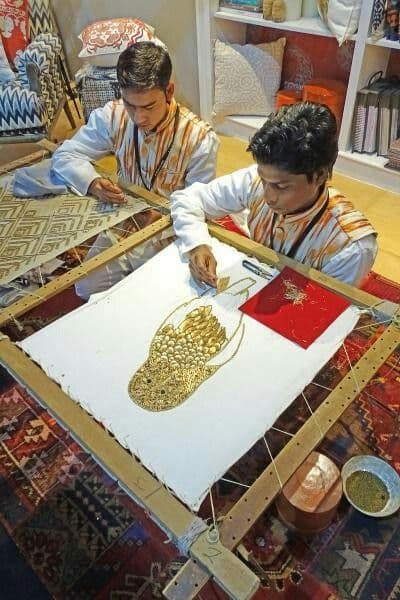
The word 'Zardosi' is Persian in origin — 'zar' meaning gold, 'dosi' meaning embroidery. It arrived in the Indian subcontinent with the Mughals and found a home unlike anywhere else in the world. What the Persian masters brought as technique, Indian artisans transformed into something transcendent — a synthesis of court craft and subcontinental sensibility that still defines Indian luxury textiles today.
"Gold on fabric is not decoration. In Zardosi, it is language — the vocabulary of ceremony and celebration.
01Materials That Make the Magic
Traditional Zardosi uses a remarkable range of metallic materials. 'Zari' is the overarching term for metallic thread — available in real gold (kachcha zari), silver, and synthetic variations. Beyond thread, Zardosi incorporates 'badla' (flat metallic strips), 'kora' (fine coiled wire), 'salma' (pre-twisted wire), 'sitara' (flat metal sequins), and 'gijai' (tiny metallic balls).
Semi-precious stones were historically embedded directly into the embroidery on royal garments — rubies, emeralds, and pearls set like jewels into the fabric itself. Today, high-quality Swarovski crystals and hand-cut glass stones serve a similar function in bridal couture.
02The Craft Process
Like Aari work, Zardosi is done on a stretched fabric frame. The artisan uses a curved needle and works the metallic threads in specific patterns — often in raised techniques that give the embroidery a sculptural, three-dimensional quality. This relief effect is achieved by first padding areas of the design with layers of thread or felt, then couching metallic threads over the padding.
A single Zardosi blouse from a master workshop can represent 80–120 hours of work. The weight of materials means that heavily embroidered garments can feel substantial in the hand — a quality that connoisseurs actively value.
03Zardosi in Contemporary Fashion
Today's Indian bridal market is the primary driver of Zardosi's continued vitality. The technique appears prominently in designer lehengas, saree blouses, sherwanis, and statement duppattas. Leading Indian fashion houses spend months sourcing, sampling, and executing Zardosi embroidery for their runway collections.
The global diaspora market has also expanded demand significantly — brides from Indian communities in the UK, USA, Canada, and Australia increasingly seek authentic handcrafted embroidery for their wedding day, valuing the cultural connection as much as the aesthetic.
Process Flow
Zardosi Creation: Step by Step
Pattern Design
Motifs drawn by hand — paisleys, florals, lattice — then traced onto the base fabric
Material Selection
Zari type, badla width, sitara style, and stone colours chosen for each design section
Padding (for relief)
Cotton or felt padding stitched to raised areas before metallic threads are laid
Thread Couching
Metallic threads are laid on the surface and secured with fine silk stitches from above
Stone Setting
Crystals, stones, and sequins applied with individual securing stitches
Quality Check
Each section inspected; loose threads secured; fabric steamed to set the work
From the Academy
Zardosi remains one of the most technically demanding and visually spectacular of all Indian embroidery traditions. Its future lies in the hands of trained artisans who understand both the ancient techniques and the demands of contemporary clients.