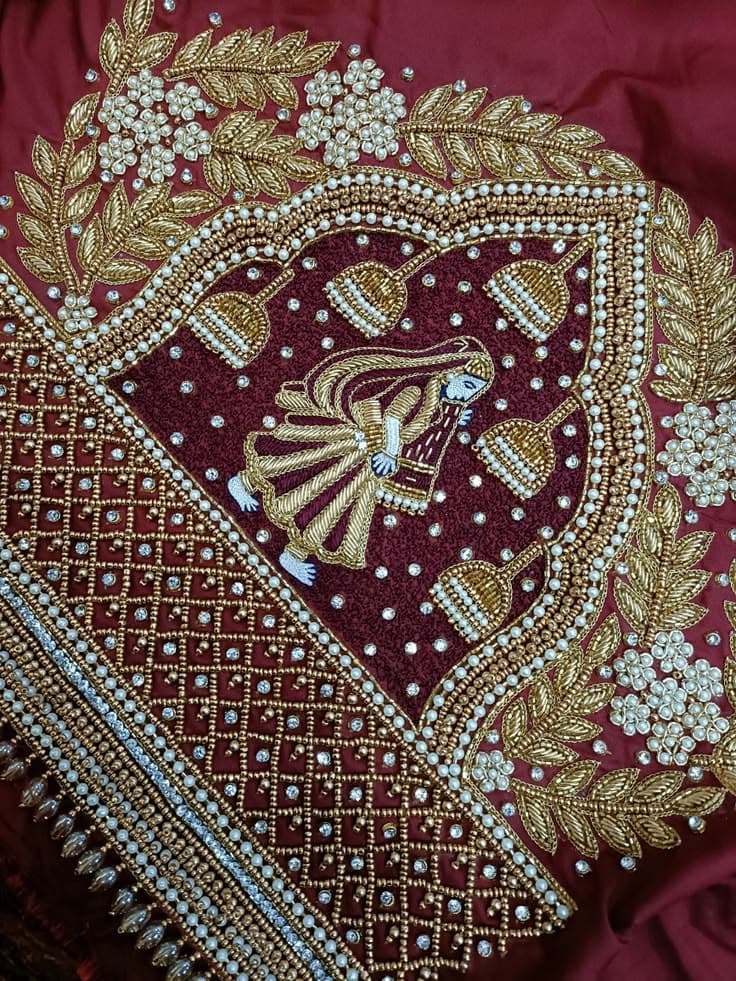
Walk into any luxury bridal boutique in India today and you will find it — that characteristic glimmer of Aari embroidery catching the light on a silk blouse or a lehenga hem. But Aari work is far more than a decorative technique. It is a living craft tradition that has survived empires, migrations, and the relentless churn of industrialisation.
"Every stitch is a dialogue between the artisan and centuries of tradition.
01Origins: The Mughal Connection
The word 'Aari' derives from the Urdu word for a hooked needle — a slender, crochet-like tool that gives this embroidery its name and its character. The technique was perfected in the imperial ateliers of the Mughal courts, where skilled needleworkers (known as 'zarduzi') created extraordinarily complex patterns for royalty. Emperors commissioned floor-length robes and tent hangings covered in Aari-stitched florals, paisleys, and calligraphic motifs — all executed in silk, gold and silver wire, and precious stone.
These craft traditions were concentrated in cities like Lucknow, Delhi, and later Kashmir and Chennai, each developing distinctive regional vocabularies. The Kashmiri Aari, for example, tends toward dense floral fills on shawls and wraps. The Lucknowi style, influenced by the nawabi courts, is more delicate — all fine curves and light khari (outline) work.
02The Tool That Defines the Craft
The Aari needle is deceptively simple: a long steel hook set into a wooden or bone handle, resembling a fine crochet hook. The fabric is stretched taut on a wooden frame — traditionally called a 'adda' — and the artisan works from above, guiding loops of thread up through the fabric from below.
This creates a characteristic chain stitch on the surface. What makes Aari distinctive is the speed and fluidity with which a trained artisan can execute these stitches — far faster than conventional needle embroidery — while still achieving extraordinary detail. A single blouse panel can take forty hours of patient work.
03Regional Styles Across India
Chennai and Tamil Nadu have their own rich Aari tradition, often incorporating bolder geometric motifs alongside the floral vocabulary inherited from Mughal influence. South Indian Aari work is heavily featured on kanjivaram silk blouses, often executed in contrasting silk thread to create a textured, jewel-like surface.
Mumbai's fashion industry has embraced Aari as a high-fashion technique, with designers like Sabyasachi and Manish Malhotra incorporating it prominently in their bridal collections. This commercial adoption has created a new generation of demand — and, crucially, a new generation of artisans training to meet it.
04The Modern Revival
For decades, Aari embroidery faced pressure from machine-made embroidery — cheaper, faster, but lacking the living quality of handwork. The revival has been driven by two forces: a growing appreciation among consumers for authentic handcraft, and a couture fashion industry hungry for exclusivity.
Institutions like Vajra Aari Academy play a critical role in this revival — training young artisans not just in the techniques, but in the business of craft: how to price handwork correctly, how to present it to clients, and how to adapt traditional motifs for contemporary aesthetics.
Process Flow
The Aari Embroidery Process
Design & Tracing
Motifs are hand-sketched and traced onto the fabric using chalk or carbon paper
Frame Mounting
Fabric is stretched taut on the adda (wooden frame) and secured with thread
Threading the Hook
Thread is loaded from below the frame; the hook pulls loops up through the fabric
Stitching
The artisan works the chain stitch in continuous fluid motion, following the traced design
Embellishment
Beads, sequins, or zari wire are added at specific points during stitching
Finishing
Reverse side is checked, knots are secured, and the fabric is steamed and pressed
From the Academy
Aari embroidery is not a museum piece. It is a dynamic, living art that continues to evolve with each artisan who picks up the hook. At Vajra Aari Academy, we believe that learning this craft is both an act of cultural preservation and an investment in a skill that will never go out of style.